What the PK numbers on a bottle mean
P refers to phosphorus and K to potassium. In general nutrient labelling, PK numbers refer to the phosphorus and potassium figures shown on the label. Exact percentages, the way they are declared and their ratios differ between products, so compare labels, not names. Read the declared analysis and directions rather than treating a product name as a verified specification.
The Monkey catalogue does not confirm an exact NPK analysis for PK 9/18. Its name alone is not a basis for assigning percentages. Monkey does not currently list a PK 13/14 product, so this guide explains how to read PK labels rather than comparing two Monkey formulations.
Where Monkey PK 9/18 fits
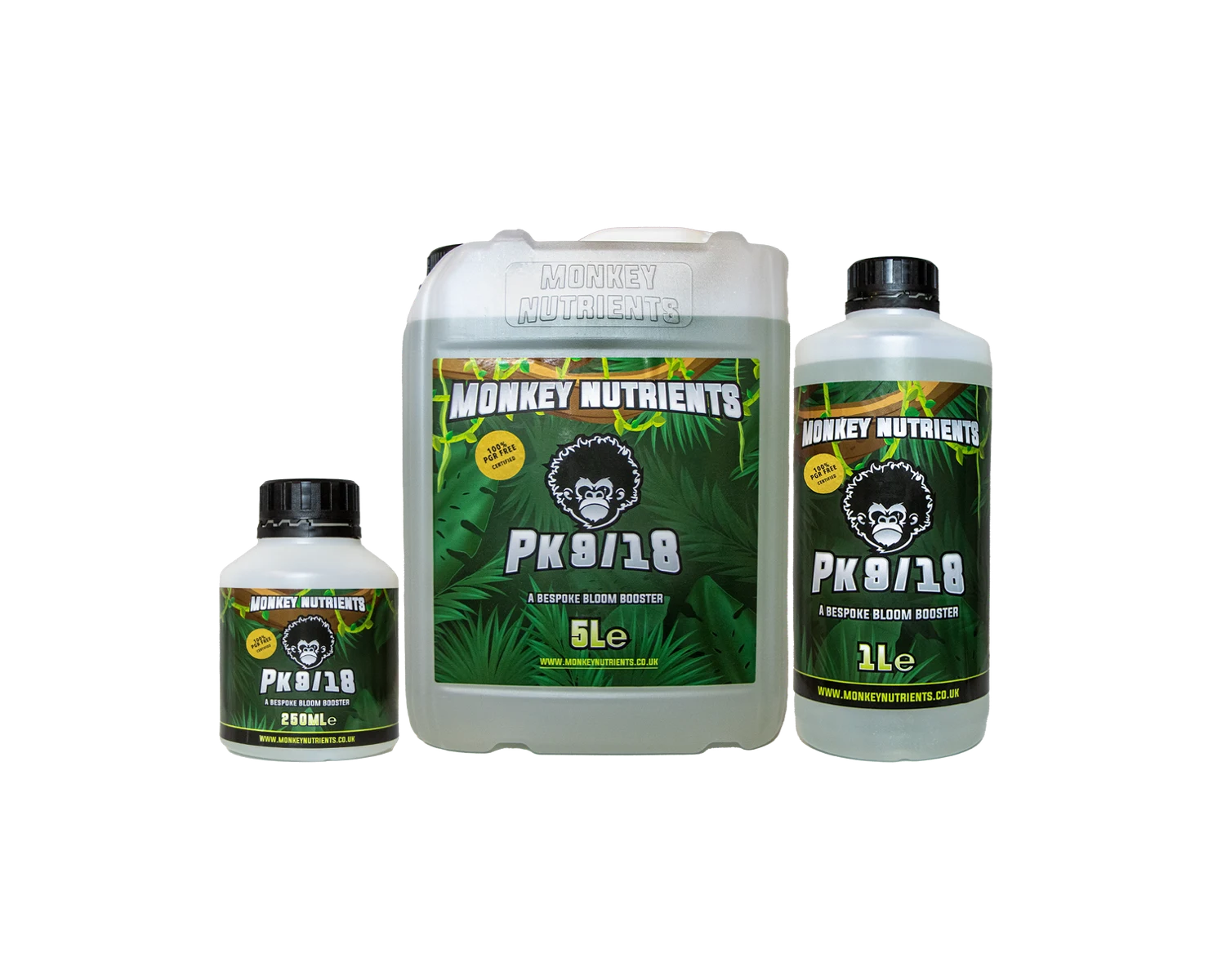
Bloom A+B remains the two-part base feed during flowering. In the Monkey PK programme, PK 9/18 is used in bloom weeks 4–6: the existing chart lists 2.5 ml per 10 litres in weeks 4 and 5, and 5 ml per 10 litres in week 6. The dose for Bloom A+B applies to each part; add equal amounts of A and B.
PK and Resin are alternative programmes. Choose the PK programme to use PK 9/18, or the Resin programme to use Resin instead; do not combine them. A PK booster is a flowering supplement, not a replacement for the base feed.
Choosing a lower-ratio or higher-ratio PK booster
A lower or higher ratio is a label comparison, not a quality ranking. Read the phosphorus and potassium declaration, the intended stage and the instructions for the product you actually use. Exact percentages and ratios differ between products, so a larger number in a name does not establish that a product is better for your grow.
Follow that product’s feeding chart rather than transferring Monkey’s dose or timing to another bottle. Do not stack two PK products. For the Monkey range, keep Bloom A+B as the flowering base and select either PK 9/18 or Resin using the corresponding programme.
PK boosters: when and how to use them
Good questions
What do P and K mean on a nutrient label?
P refers to phosphorus and K to potassium. Read the declared analysis on the label: exact percentages, declarations and ratios can differ between products. A product name alone does not confirm its analysis.
Is a higher-ratio PK booster better?
A higher or lower ratio is not a quality ranking. Compare labels and follow the feeding chart for the product you use. Do not transfer the dose from another product or stack two PK products.
When should I use Monkey PK 9/18?
Use Monkey PK 9/18 in bloom weeks 4–6 of the PK programme, with Bloom A+B as the base feed and instead of Resin. The chart lists 2.5 ml per 10 litres in weeks 4–5 and 5 ml in week 6.
Does Monkey offer PK 13/14, and can I combine PK with Resin?
Monkey does not currently list a PK 13/14 product. PK 9/18 and Resin belong to alternative Monkey programmes; select one programme rather than combining them.