Ask about your own supply
Start with your local water supplier’s water-quality information. Many suppliers let you check hardness using a postcode or supply-area search. A postcode lookup is useful advice, but it does not replace checking a particular grow: treatment, storage and the use of reverse osmosis can change what reaches the reservoir. Record whether the source is tap water or RO water and keep that description alongside the feeding programme. If you cannot confirm hardness, ask the supplier rather than assuming that every address in a county has identical water.
Calcium and magnesium have distinct roles
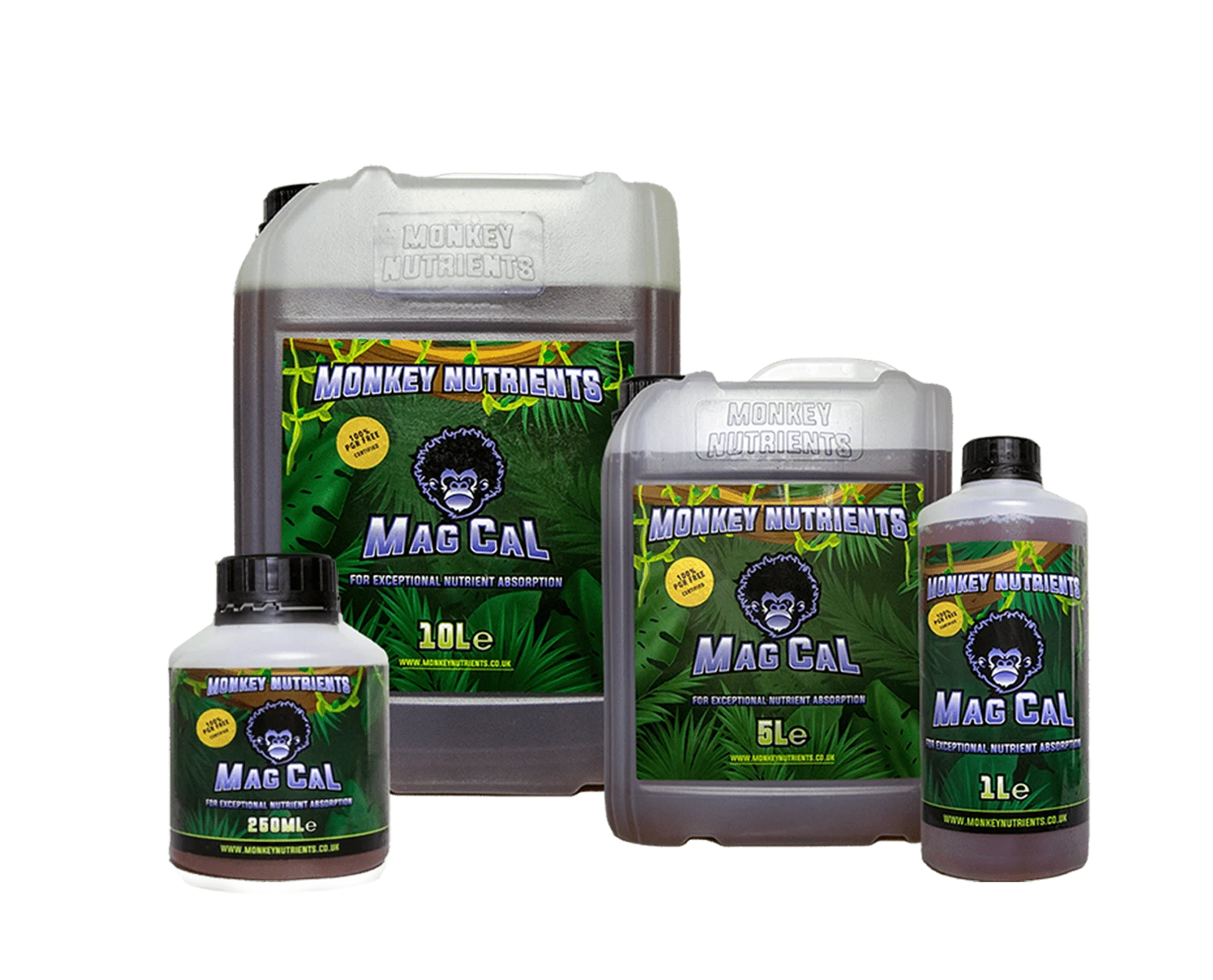
Magnesium is at the centre of chlorophyll, while calcium contributes to cell wall strength. Monkey Mag Cal combines these secondary nutrients with trace elements. It is particularly relevant in soft water areas, with RO water and in coco. Coco’s high cation exchange capacity can bind calcium and magnesium, so medium choice matters as well as water hardness. This does not give a universal dose for Mag Cal. That dosing detail has not been supplied and should be confirmed with your stockist before use.
Use a range designed for UK water
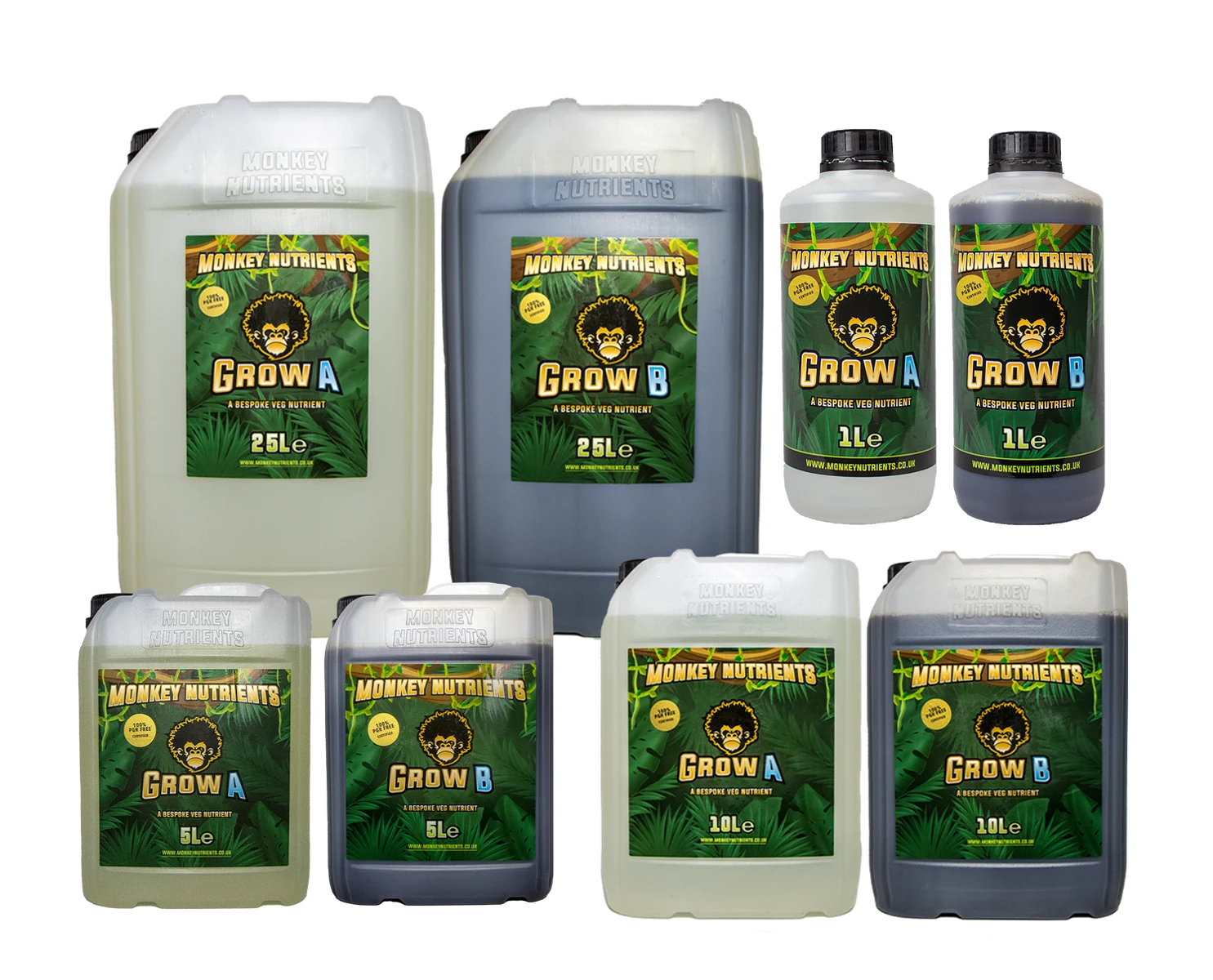
Grow A+B and Bloom A+B are designed for UK hard and soft water. The supplied chart uses the same stage-based framework for coco, soil and hydro and specifically calls out Mag Cal for coco. That makes the starting point clear without implying that every plant, medium and water supply is interchangeable. Keep your observations alongside the schedule. Avoid changing base feed, water source and several supplements at once if you want to understand which change helped. A consistent record is more useful than a collection of unrelated recommendations.
Read the chart as a complete programme
The Monkey feeding chart is written as a ratio per 10 litres of water. Its headings distinguish vegetative growth, bloom and flush, and the programme toggle selects PK or Resin. Before measuring anything, check that the week on the screen is the week you intended. A veg week and a bloom week can share a number but involve different base feeds. The chart’s ranges should remain ranges in your notes. A displayed interval does not mean that the website has secretly chosen one precise value for your crop. Read the full row and the surrounding programme rather than lifting a number out of context.
The calculator is a convenient way to change reservoir volume without changing the underlying chart. Enter litres, choose the week and programme, and read the millilitres for each included product. If you double the water volume, the confirmed amounts double; if you halve it, they halve. A product without a confirmed dose is not automatically assigned one. This simple boundary is important: arithmetic can scale an instruction, but it cannot supply missing product guidance.
Keep water, medium and environment in the picture
Monkey nutrients are intended for UK hard and soft water and for coco, soil and hydro. That gives a common framework, but it is still worth describing the grow accurately. Write down your medium, water source and programme so that a conversation with a stockist begins with useful information. For coco, the chart explicitly calls for Monkey Mag Cal. Its dose still needs confirmation, so ask rather than borrowing another brand’s figure. More information is not the same thing as more bottles. Clear inputs and a readable schedule are often the best starting point for a productive question.
The chart also carries environmental reference information. It lists pH 5.5–6.5, temperature 20–27°C, and week-specific EC and humidity values. Normal and closed-room EC are separate rows; do not silently substitute one for the other. These figures belong to the supplied chart. They are not a full diagnosis of every indoor setup. A useful grow record captures what was measured and when, not merely what a target row said. If something changes, that record helps explain the sequence without relying entirely on memory.
Avoid solving an unknown problem with an unknown dose
When advice is missing, keep the gap visible in your own decision-making. A product name, a photograph or a bottle size cannot confirm an NPK analysis or a dilution rate. Monkey’s supplied information deliberately leaves some details open: Mag Cal dosing, Ultra Zyme’s technical instructions and certain size or analysis confirmations. The website hides unconfirmed fields instead of presenting guesswork as a specification. Your stockist can help you obtain the latest confirmed directions. Until then, an honest unanswered question is more useful than a confident invented answer.
Likewise, do not assume every supplement should run throughout every week. Root Shoot, Boost, PK 9/18 and Resin each have their own chart windows. Stress has a consistent role through the twelve growth and bloom weeks, but not a listed flush dose. Monkey Mist is a ready-to-use leaf spray, not a reservoir additive with a scaled millilitre instruction. Keeping these jobs distinct helps the system stay simple. If the crop or timetable differs from the chart, describe that difference before asking for a recommendation.
A practical next step for your grow
Start by opening the feeding chart and checking the programme you plan to use. Then read the relevant product page for its description, mechanism, ingredients and confirmed instructions. Safety data sheets are linked where supplied. A safety sheet is valuable for handling information, but should not be treated as a substitute for the feeding programme. Contact Monkey or speak with a stockist if something is unclear. The range was developed by UK growers with more than two decades of nutrient-industry experience, with more than two years of development and testing before its 2021 launch.
The aim is a system that growers can understand, trust and use with confidence, not a bottle for every unexplained problem. Choose a starter or expanded kit around an understood role, retain the correct programme and measure the actual reservoir volume. Keep your notes straightforward enough that you can explain the grow to somebody else. That is science made simple in practice: accurate information, a consistent schedule and no invented shortcuts. UK born. Grower led. Built from experience.
Before buying, separate confirmed availability from the product description. There are no published prices in this catalogue, and a size listed for one product is not automatically a size offered for another. Root Shoot sizes require confirmation, while Monkey Mist sizes are not supplied. Ask your stockist about the product and size you actually need. A website photograph can help identify a bottle, but does not override the current verified product information.
A good question to Team Monkey includes the product name, whether the grow is in veg or bloom, the medium and the water source. If you are asking about the chart, include the programme and reservoir litres too. Those details make it easier to keep the answer connected to your actual grow. Do not turn advice for a different stage into a new instruction without checking it. The system is intended to stay understandable from start to finish: roots, shoots and fruits, with health-support products used for clear, distinct purposes.
Good questions
Can I use Monkey in coco, soil and hydro?
Yes. The Monkey range is designed for coco, soil and hydro. Follow the feeding chart, and use Monkey Mag Cal for coco.
Does it work with hard and soft water?
Grow A+B and Bloom A+B are designed for UK hard and soft water. Mag Cal is particularly relevant for soft water, RO water and coco.